

Schiphol is working to minimise exposure among apron staff to Aircraft and Diesel Engine Emissions (VDME), and therefore ultrafine particles (UFP). This includes work on new arrival and departure procedures for aircraft. LVNL is closely involved in this, together with KLM, because the plans have an impact on daily operations. Operational trials are being used to assess whether the new procedures have an effect. The impact of the changes on safety and capacity is also being examined.
In spring 2025, MovingDot was given the opportunity to manage the first trial at the D concourse. For six weeks, UFP-optimised pushback and engine start-up procedures were carried out to understand their effects under different conditions, such as wind conditions and traffic demand. The measurements showed that average ultrafine particle emissions on aircraft stands can be reduced by 20% compared with current procedures.
In the second half of the year, this was followed up with additional measurements at the D concourse, the start of a baseline measurement in the FG apron, and further analyses and alternatives for a more generic design. The design needs to be workable at Schiphol, where infrastructure and schedules are extremely congested, without negative consequences for safety, capacity or costs.

On behalf of myself personally and LVNL, thank you for your positive commitment and perseverance on this challenging topic! We have succeeded in finding a direction that will allow us to move forward in 2026. That is a major achievement and provides the basis from which we can now start implementing.
SANDER NIEMEIJER, PROGRAMME MANAGER SUSTAINABLE GROUND MOVEMENTS, LVNL
MovingDot expert Justin The
From the trial at the D concourse, we learned that positioning aircraft straight on the centreline helps ensure that less ultrafine particulate matter ends up on the aircraft stands. Starting aircraft engines later also results in later and lower emissions. It was great to work with a team represented by several organisations towards a common goal. It is certainly not an easy task, but for the people working on the apron it represents a very important improvement in their working conditions.
MovingDot consultant Marjan Sprenkels
I was able to take over from Justin after the successful trial at the D concourse had been completed. Before implementation could proceed, we needed to reach sector-wide agreement that the new procedures would be workable for LVNL, Schiphol, airlines and handlers. Not only at the D concourse, but also at other concourses. This means looking together at the processes and effects, and understanding what is and is not possible. I look back on the final result with satisfaction: by focusing on what can work, there is now a UFP-optimised process design with less intrusive changes to the departure procedures on the aprons.
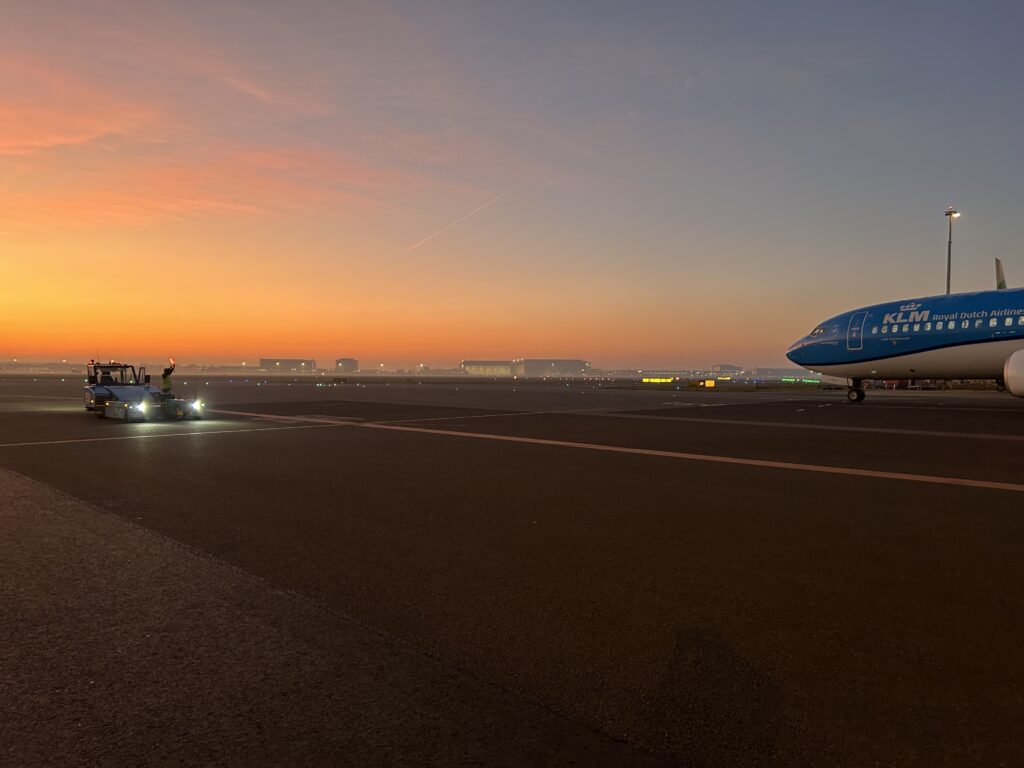
Photo credits: Dave Goossens, Amsterdam Airport Schiphol